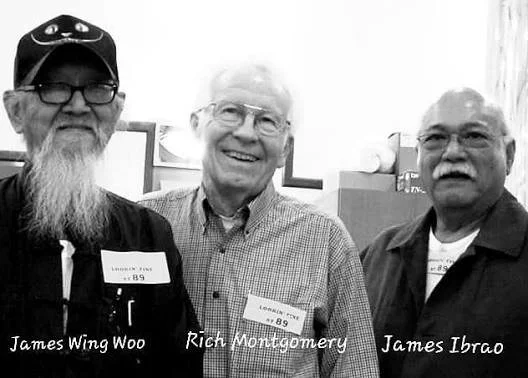
It is not widely known, particularly among the younger generations of Kenpo practitioners, that James Ibrao and Jimmy Wing Woo were two important figures in the early development of American Kenpo and the Tracy’s Kenpo system. Their influence was significant, yet for decades their names remained largely unknown to many practitioners, especially those training on the East Coast.
In the early 1980s, few, if any, of us training in Tracy’s Kenpo schools on the East Coast were familiar with these two remarkable martial artists. Our instruction centered almost exclusively on the established Tracy’s Kenpo curriculum: the required self-defense techniques and katas associated with each belt rank.
At that time, the curriculum consisted of approximately 40 techniques per belt, along with two required katas. The yellow belt had not yet been introduced into the ranking structure we followed.
We learned what we were taught, practiced diligently, and advanced through the system. Yet very little information was available regarding how the Tracy’s Kenpo system had actually been developed, where its forms originated, or who had contributed to its creation beyond Al, Jim, and Will Tracy.
For many of us, that was simply the extent of our historical knowledge.
It was not until 1999, at the very first Gathering of Eagles, that many practitioners, myself included, were introduced to James Ibrao and numerous other legendary figures from Kenpo's formative years.
For those of us who had spent decades training within the system, this was an extraordinary opportunity to encounter individuals whose contributions had helped shape the martial art we had devoted so much of our lives to studying.
But it also raised an important question:
Why had James Ibrao and Jimmy Wing Woo remained so far in the background of Tracy’s Kenpo history?
Why were their names not more widely discussed? Why had their contributions to the development of the forms and the Chinese influences within Kenpo received so little recognition?
Unfortunately, we may never know the complete answer. Many of the individuals who could provide firsthand explanations have since passed away.
However, the absence of those answers should not prevent us from examining the history and recognizing the contributions of these two extraordinary martial artists.
One of the most significant and often overlooked aspects of Tracy’s Kenpo history is the influence of James Ibrao and Jimmy Wing Woo on the development of its forms.
James Ibrao is credited in accounts of early Kenpo history with creating or helping develop important katas that became part of the Tracy’s Kenpo curriculum.
Jimmy Wing Woo is credited with developing or influencing forms including the Book Set and Tiger & Crane, both of which reflect Chinese martial arts principles and traditions.
There are also historical accounts attributing the development of Short Forms and Long Forms 1, 2, and 3, in varying degrees, to the work and influence of Ibrao and Woo.
The precise authorship of individual forms deserves continued historical research, particularly where accounts differ. Nevertheless, the contributions of these two men to Kenpo's technical and philosophical development should not be overlooked.
To fully appreciate their contributions, it is important to understand the relationship between Kenpo and the traditional Chinese martial arts.
In many traditional Chinese martial arts systems, forms serve as the principal means of preserving and transmitting fighting principles, movement, structure, and application. While individual techniques certainly exist, they are often taught within the broader framework of forms and their practical applications.
Kenpo developed a somewhat different approach.
The self-defense techniques provide practical responses to specific attacks, while the forms preserve combinations, transitions, body mechanics, and principles that connect the system together.
The influence of Chinese martial artists such as Jimmy Wing Woo helped strengthen this relationship between traditional Chinese forms and the evolving American Kenpo curriculum.
Another important aspect of that era was the culture surrounding martial arts instruction.
During the 1970s and early 1980s, students training in many Tracy’s Kenpo schools were generally expected to remain within their own system. Exploring other martial arts, particularly Chinese systems outside the Kenpo organization, was not always encouraged.
As a result, many practitioners had little exposure to the Chinese martial arts traditions that had helped influence portions of the very curriculum they were studying.
We practiced the forms, learned their sequences, and worked toward technical proficiency. Yet few of us had the opportunity to explore their deeper historical origins or the Chinese martial arts principles embedded within them.
Looking back, this separation may have contributed to the limited recognition of individuals such as James Ibrao and Jimmy Wing Woo.
Giving Credit Where Credit Is Due
The purpose of revisiting this history is not to diminish the extraordinary accomplishments of Al, Jim, and Will Tracy.
Their contributions to the organization, expansion, and preservation of Tracy’s Kenpo are undeniable.
Rather, it is to recognize that the development of a martial arts system is rarely the work of only a few individuals.
Kenpo evolved through the knowledge, experimentation, collaboration, and contributions of numerous remarkable martial artists.
James Ibrao and Jimmy Wing Woo deserve to be included prominently in that history.
Their influence extended beyond the creation or development of individual forms. They helped establish a connection between American Kenpo and the rich traditions of Chinese martial arts.
As we work to preserve the history and legacy of Tracy’s Kenpo for future generations, we have a responsibility to recognize those whose contributions may have been overlooked or forgotten.
James Ibrao and Jimmy Wing Woo should no longer remain in the background of that story.
Their names, their knowledge, and their contributions deserve to be remembered.
Preserving the history of Tracy’s Kenpo means telling the fullest story possible — including the stories of those who helped build the system but never received the recognition they deserved.